How Drunken Monkey Built a Category Before Scaling
How Drunken Monkey Built a Category Before Scaling
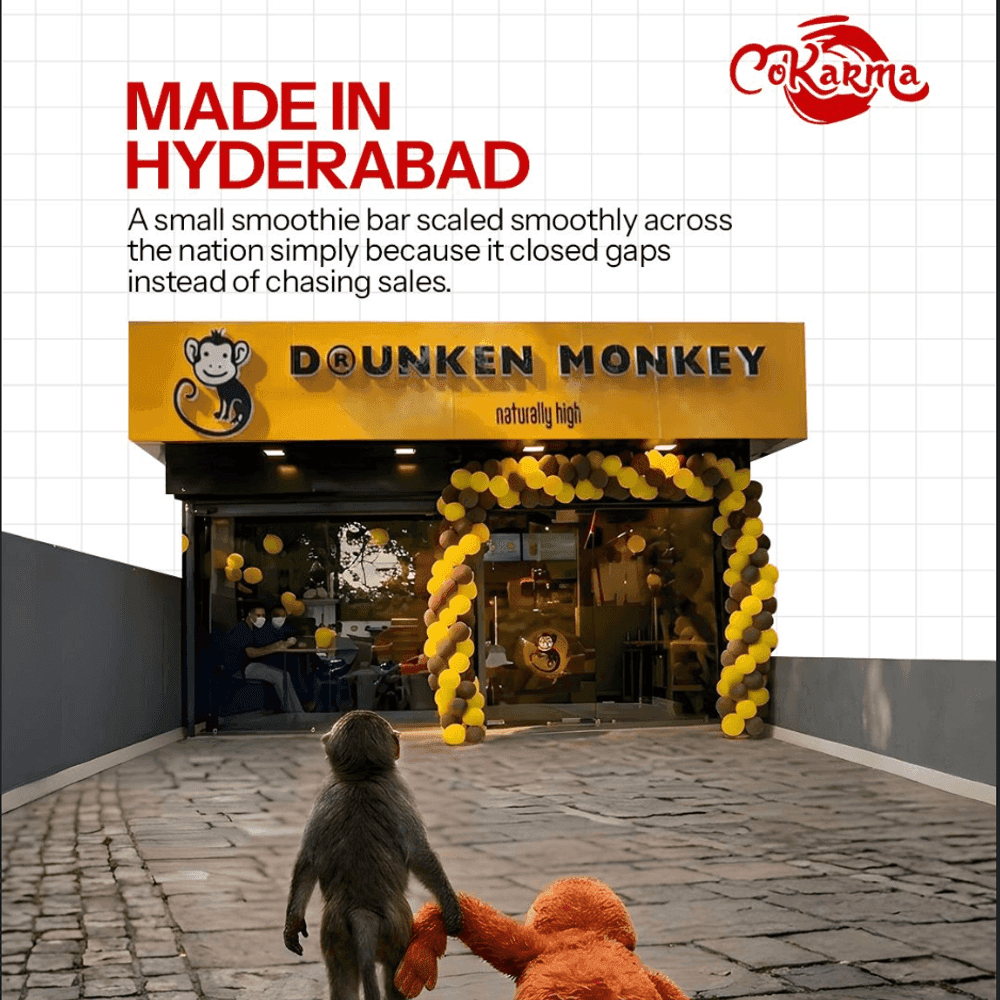
Most people in Hyderabad remember the first time they saw a Drunken Monkey outlet.
Small store.
Bright yellow branding.
A menu full of smoothies with strange names.
It didn’t look like a typical juice shop.
And that was the point.
In 2016, Samrat Reddy started Drunken Monkey with a simple observation.
India drinks a lot of juice.
But India did not really have a smoothie culture.
Samrat Reddy started with a simple observation.
India was becoming more health conscious.
But the beverage market hadn’t caught up.
So instead of competing with existing juice shops, the brand did something smarter.
It created its own lane.
Real fruit.
Protein blends.
Smoothie bowls.
Dozens of flavour combinations.
Something quick.
Something healthy.
Something that felt global.
The first stores were small.
But the concept was sharp.
Walk into the store and you notice three things immediately:
• Fruit everywhere
• Blenders running non-stop
• A large menu with dozens of smoothie options
It felt global.
That experience mattered because the brand was not trying to compete with neighbourhood juice stalls.
It was building something new.
The real growth came from one decision.
Franchising.
Instead of expanding slowly with company-owned outlets, they created a model that entrepreneurs could plug into.
The brand chose a route that many successful food brands use when the format is replicable.
Franchising.
The model made expansion easier.
Entrepreneurs could run outlets with a clear operating playbook.
The menu stayed standardised.
The brand identity remained consistent.
That structure allowed the brand to move faster than a typical company-owned expansion model.
In less than a decade, the numbers tell the story.
• Founded in Hyderabad in 2016
• 300+ outlets across India
• Presence in 20+ cities
What started as a local experiment is now one of India’s largest smoothie chains.
And interestingly, most of that growth happened through store-led expansion, not massive marketing.
Many consumer brands succeed because they do one thing well before scaling.
They don’t start by chasing scale.
They start by solving one clear gap.
Drunken Monkey did three things well:
1. Built a product people didn’t easily find elsewhere
2. Created a store format that was easy to replicate
3. Entered a category that barely existed in India
Once those pieces aligned, expansion followed naturally.
Hyderabad has quietly produced many brands that follow this pattern.
They start small.
Solve a clear gap.
And then scale across the country.
Drunken Monkey is one of those stories.